
Most enterprises aren’t failing at AI because the technology doesn’t work. They’re failing because they never built the operating model to run it.
I’ve worked with dozens of organizations over the past two years — mid-market to Fortune 500 — and the pattern is almost identical every time. The AI pilot looks promising. The board is energized. The vendor demo checks every box. Then six months later, nothing has moved. The project is “in flight” but not landing anywhere.
The problem isn’t the model. The problem is what surrounds it.
Problem 1: The Prompting Skill Gap
Companies assume that because employees can use ChatGPT personally, they can deploy AI professionally. These are completely different skills. Personal AI use is forgiving — the stakes are low, iteration is instant, and there’s no compliance layer. Enterprise AI use requires structured prompting, context engineering, output validation, and an understanding of where the model fails.
Without closing this gap, even the best AI tools sit underutilized. Teams revert to old workflows because the new ones require expertise they don’t have. Training helps, but it’s not enough without the infrastructure to support consistent, governed AI use across the organization.
Problem 2: Vendor Lock-In Masquerading as Strategy
The SaaS model trained enterprises to adopt point solutions for every problem. Now every department has an “AI tool.” Sales has one. Marketing has one. Legal has one. IT is fielding requests for three more.
The result is a fragmented stack where no single system can see the whole picture — and where switching costs grow with every passing quarter. True enterprise AI strategy doesn’t mean picking the best tool in each category. It means building a coordination layer that can orchestrate across tools, models, and workflows without being hostage to any single vendor.
Problem 3: Shadow AI and the Governance Gap
When official AI initiatives move too slowly, employees find workarounds. They use personal accounts. They copy-paste proprietary data into consumer LLM interfaces. They build unofficial automations that nobody in IT knows about.
This isn’t a discipline problem — it’s a systems problem. People are using AI because it works and because they need it. When the enterprise doesn’t provide a governed path, they’ll find an ungoverned one. The answer isn’t to lock down access. It’s to build an infrastructure where governed AI use is the path of least resistance.
Problem 4: No Business Context, No Business Value
General-purpose AI models are powerful. But they don’t know your pricing rules, your compliance requirements, your customer history, or your internal approval workflows. Without business context, every interaction starts from zero. Every output requires manual review and correction. The “productivity gain” evaporates into quality control overhead.
The companies seeing real ROI from AI aren’t just using better models. They’re feeding models better context — connecting them to the CRM, the ERP, the policy documents, the institutional knowledge that actually defines how the business operates.
Problem 5: Departmental Silos Kill Enterprise-Scale Impact
AI initiatives that start in one department rarely escape it. Finance builds an automation. Marketing builds a different one. Neither integrates with the other, and neither is visible to leadership as a coherent capability. When the CFO asks “what is our AI strategy,” the honest answer is “we have fifteen separate experiments.”
Enterprise impact requires cross-functional coordination. The agents handling customer inquiries need to communicate with the agents processing orders, which need to notify the agents monitoring compliance. That requires an orchestration layer — not more isolated tools.
The Missing Layer: An AI Operating Model
Every one of these five problems has the same root cause: enterprises are adopting AI capabilities without building the operating model to run them.
An AI operating model isn’t just a technology choice. It’s the governance framework, the skill infrastructure, the integration architecture, and the audit mechanisms that allow AI to operate at enterprise scale — safely, repeatably, and measurably.
The companies winning with AI aren’t buying better tools. They’re building better operating models. The technology is table stakes. The governance, the context layer, the orchestration — that’s the differentiator.
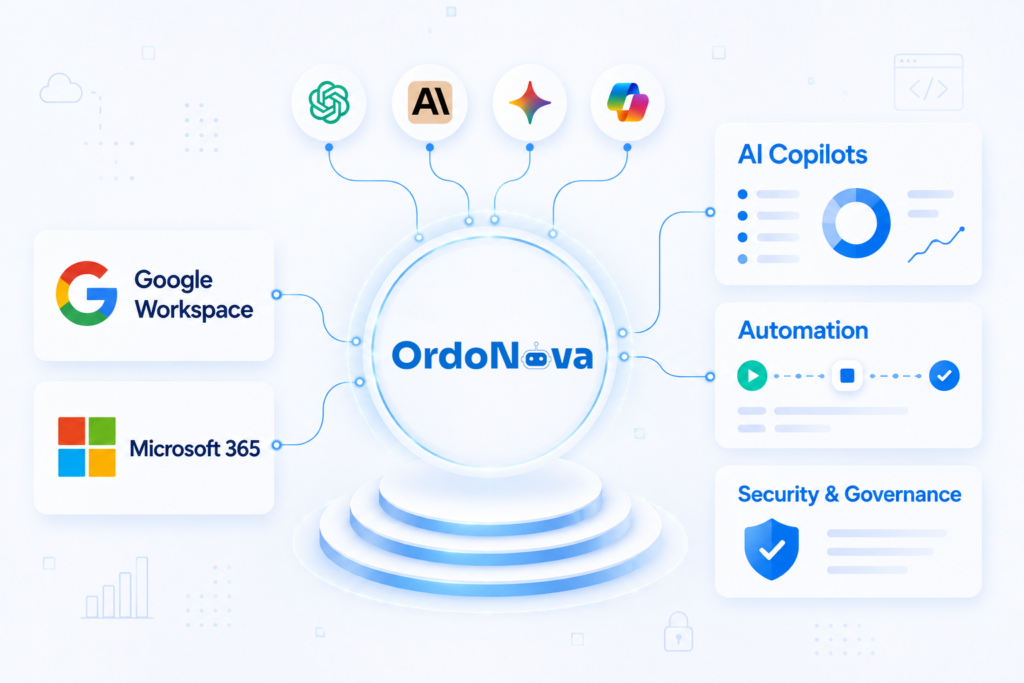
This is exactly what we built OrdoNova to solve. BotSpot provides the governed marketplace of AI agents — purpose-built, auditable, and policy-compliant. BotWorks is the orchestration engine that connects those agents to each other and to your business context, turning isolated AI tools into a coordinated AI workforce.
Every agent action is logged. Every workflow is visible to the humans who need to see it. Every decision point has a human-in-the-loop option. That’s not a limitation — that’s the point. Humans control AI. Not the other way around.
What This Means for Your AI Strategy
If your AI initiative is stalled, start by asking these questions:
- Can you trace every AI output back to the input, the model, and the business rule that governed it?
- Do your AI tools share context — or does each one operate in isolation?
- Is your governance framework a blocker or an enabler? Are employees working around it?
- Do you have a cross-functional AI coordination function, or is AI still a department-by-department experiment?
The answers will tell you whether you have an AI capability problem or an operating model problem. In almost every case I’ve seen, it’s the latter.
The good news: an operating model problem is a solvable problem. It requires architecture and process, not waiting for the next model release.
What has been your biggest challenge with enterprise AI adoption? I’d like to hear what you’re seeing on the ground.